
Why Craftsmanship, Not Charity, Is the Future of the Artisan Economy
CFC Member Spotlight: Meenu Devrani of Fyoli Fyoli
Author and interviewer: Stella Hertantyo
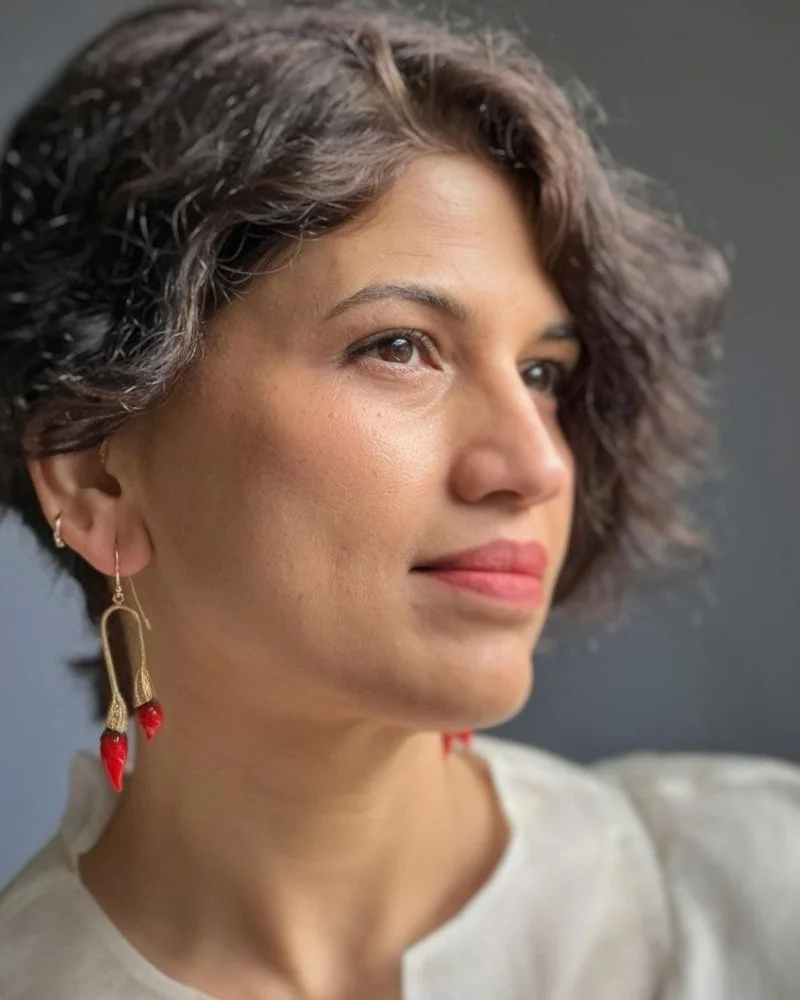
Meenu Devrani is the founder of Fyoli Fyoli, a fashion and accessories social enterprise dedicated to elevating Indian artisanal communities by building an economy rooted in equity, where heritage skills can evolve and thrive.
Drawing on her experience of over a decade as a silversmith and multidisciplinary artist, Meenu brings a deeply empathetic understanding of the challenges facing grassroots craftspeople in underserved communities in India. Her designs fuse contemporary and heritage crafts, inspired by nature, ancient cultures, and spirituality — reflecting her identity as a South Asian Indian and American woman.
I interviewed Meenu in the Conscious Fashion Collective Membership as part of our Member Spotlight interview series.
Below are some of the highlights, including:
What it takes to work with artisans in underserved communities who are preserving heritage skills,
Building a business that champions excellence in craftsmanship over the charity narratives that are often associated with the handmade economy,
And how to approach effective, empathetic, and ethical communication with artisans.
What was the moment you knew you wanted to start Fyoli Fyoli?
Fyoli Fyoli emerged at a moment when the fragility of the handmade economy became impossible to ignore. Deep in the throes of the COVID pandemic, the idea began to take form. As global systems stalled, artisan communities – already operating without structural support or safety nets – faced collapsed markets, broken supply chains, and even starvation. Skills passed down through generations were suddenly no longer enough to sustain livelihoods.
During this time, as a practicing studio artist, I became deeply aware of the privilege of being able to continue creating while many craftspeople were left without access to markets or income. Fyoli Fyoli grew from the belief that creative practice carries responsibility and that design can be a bridge rather than a way of extraction.
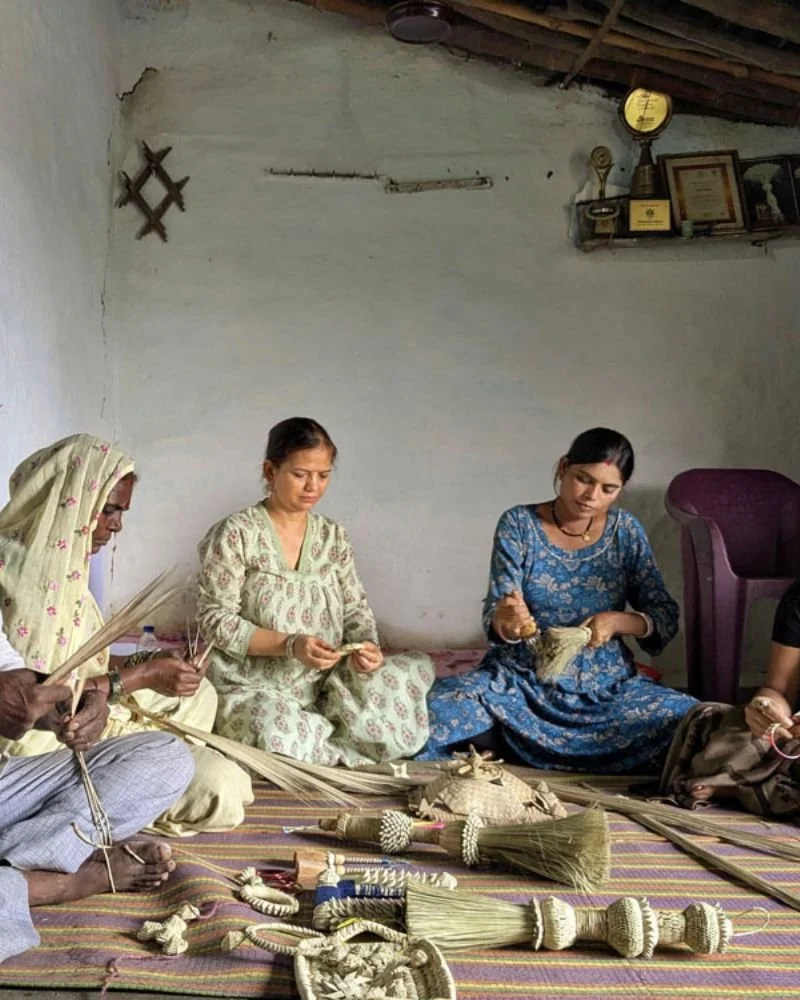
Migration is central to this story. My own family history is shaped by it, with my father leaving his Himalayan village in search of work, carrying with him a lifelong longing for land, language, and community. This same pattern repeats across artisan communities, where the erosion of craft livelihoods pushes makers into precarious urban labor, severing ties between people, place, and ancestral knowledge.
What are some of the heritage skills that you are aiming to preserve with Fyoli Fyoli?
Our journey into heritage crafts has always been guided by two compasses — the search for superior sensory experience and the commitment to safe, natural materials. That search led us to some of India's most endangered craft traditions.
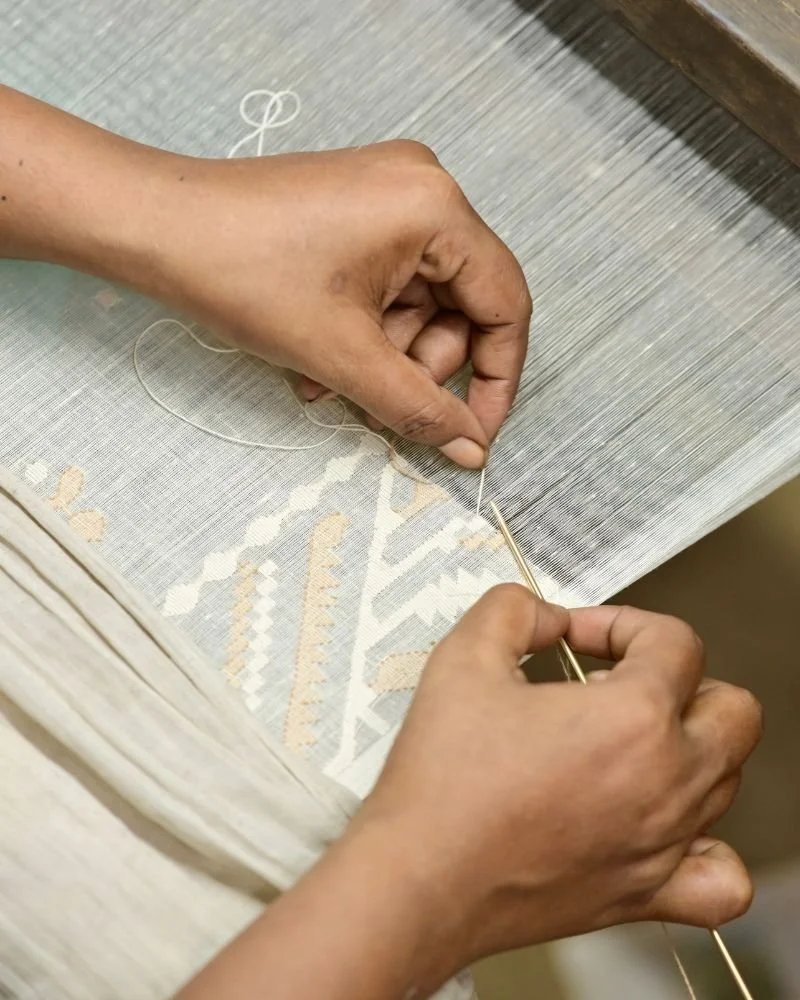
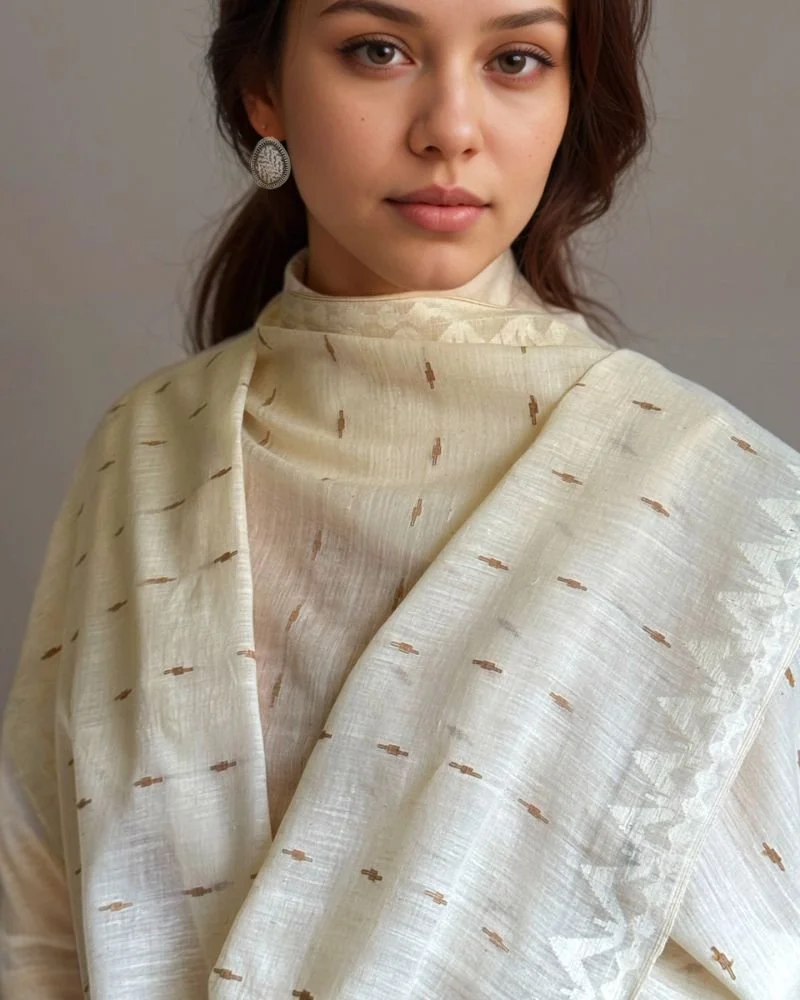
We work with Jamdani weavers in West Bengal, a UNESCO-recognized tradition so delicate it can only be worked in the natural humidity of early morning and late evening. In Rajasthan, we support Kota self-checkered weaving — a craft being decimated by power loom imitations — and Patwa hand knotting, where only six families still actively carry on the legacy.
We use high-count Khadi and indigenous Malda mulberry silk, both under threat from cheaper industrial alternatives. Our hand block printing work spans Bagh in Madhya Pradesh, batik in Gujarat, and Sanganer near Jaipur.
In Kutch, we've partnered with natural dye Bandhni artisans from historically marginalized communities. Through my silversmithing background, I was drawn to Bandlu gold foil silversmithing — a nearly extinct technique I stumbled upon in Jaisalmer.
Most recently, we've begun collaborating with tribal communities in Gujarat, Madhya Pradesh, and West Bengal on jewelry and home objects made from sustainable plant materials.
Each of these crafts found us through curiosity, through walking slowly, through listening. And each one has deepened our conviction that the most important things worth preserving are not objects, but ways of knowing.

Can you share an example of what it takes to create one of your slow, artisan-made products?
Our Magnolia Seedpod bracelet is a celebration of nature, culture, and craft in one stunning form — blending our in-house designed contemporary components with traditional thread-knotting practiced by generational Patwa artisans in rural Rajasthan.
Like most of what we create, this bracelet began with nature. The magnolia seedpod — that gorgeous form that clusters and repeats, tapering gracefully at both ends — became a little obsession. The specific design challenge I set for myself was pliability: I wanted it to adjust to the wrist, not feel stiff.
I began by hand-sculpting the original component in metal clay, working a textured interior into the form, which took about five hours of focused making. From that original sculpt, we created multiples in gold-plated brass, which took three weeks, then sent the components to the Patwa artisans to be hand-knotted into a five-row tapered design.
What followed was four rounds of iteration. The pivotal challenge turned out to be something entirely invisible to the eye — the placement of tiny loops on the back of each component through which the thread passes. These hidden loops are the architectural heart of the bracelet. We had to remake the components entirely to get their placement right.
This is what good design sometimes looks like: the thing that makes everything work is the thing no one ever sees.
From ideation to the final approved sample, the whole process took about three months, and it was worth every moment. This bracelet has been loved by so many customers, and that warms our hearts deeply. Not through shallow exoticizing of heritage crafts, but through sitting together, solving design problems together, with mutual respect for the skills, vision, and knowledge each of us brings.
What are some of the opportunities and challenges of working with the unorganized handmade sector in underserved communities?
Working with the unorganized handmade sector holds immense potential for change in socio-economic impact, design development, and digital literacy. We often find that the craft skills themselves are exceptional and the raw materials inherently sustainable. It is frequently the absence of formal design education and refined finishing that limits a craft's broader appeal. We spend considerable time sampling new product ranges that draw on existing craft skills while educating artisans about how finishing elevates both appeal and longevity.
One opportunity we deeply treasure is fusing craft techniques across regions to create something entirely new. Combining hand-blown glass with metal components, Patwa thread knotting with contemporary forms, hand-carved bamboo with hand-plaited date palm — these cross-craft dialogues produce objects that are both innovative and deeply rooted.
There is also a climate story here that the world is only beginning to catch up to. Indigenous artisan communities have long practiced what sustainability advocates are urgently calling for — working with local materials, at a human pace, wasting very little.
The challenges are real, too. The rhythm of rural artisan life is rooted in seasons, ecology, and faith, and honoring that rhythm has been one of our most important lessons. We never press artisans with rush orders, and we don't operate on fixed seasonal collections.
Scaling is an honest limitation — the beauty of slow handwork is also its constraint. We navigate this through transparency with our customers, generous return policies, and framing natural variation as the signature of the human hand.
The market itself presents a quiet threat. Cheap imitations and power-loom textiles mimicking heritage weaves have created enormous consumer confusion, directly responsible for the disappearance of many crafts. Educating consumers about what authentic handmade truly means remains one of our most important ongoing responsibilities.
Can you tell us more about the familial and collective nature of ancestral crafts?
Ancestral crafts carry a legacy that stretches back further than memory. For the families who practice them, craft isn’t simply an occupation — it is identity, continuity, and a way of life. Skills are not taught from a textbook but absorbed through watching and doing, through years of immersive participation alongside elders.
A beautiful example is the Patwa community of Rajasthan, who make all of our yarn tassels and embellishments. Traditionally, Patwas specialized in twisting, braiding, and knotting colorful threads to create objects of deep ritual value — sacred threads, ceremonial necklaces, ornament strings for marriages, festivals, and temples. We work with one multi-generational family at the heart of this tradition: grandmother Prabhati Devi at 85, her son Kailash ji at 68, his sons Amit and Ajay, their wives, and neighbors who join when larger orders come in.
In this single family, you see the full arc of what ancestral craft truly means — knowledge flowing from grandmother to grandchild, labor shared between spouses and siblings, community drawn in and supported. It isn’t a supply chain, but rather a living tradition.
How are you championing excellence in craftsmanship over the charity narratives that are often associated with the handmade economy?
At its core, this is about love. There is a real, felt joy in the handmade process, and excellent craftsmanship with mindful, considered details speaks more lovingly and loudly than any words ever could.
I believe wholeheartedly that handcrafted objects must stand on their own merit — through thoughtful design, material integrity, and a deep embrace of cultural context. The value of what we make lies in its excellence, not in narratives of rescue. We would far rather spend our energy telling you how extraordinary the craftsmanship is, how alive these traditions are, how much skill and devotion go into every piece.
This is personal for me. As a young adult, I was guilty of pity-buying from artisans — purchasing something simply so they could make a sale, not because the object moved me. That experience made me acutely sensitive to what that dynamic feels like. It diminishes the maker, and it diminishes the object.
I have also watched certain businesses use the image of the struggling craftsperson not to elevate them, but to engage in what I can only call “craft-washing” — borrowing the aesthetic and story of handmade tradition while doing very little to genuinely honor or sustain it. We want no part of that. Our commitment is to excellence, dignity, and the kind of love that shows up in the work itself.
Effective, empathetic, and ethical communication with artisans is key when building an artisan-made business. How do you approach this?
As a maker myself, I think like a maker. I know the creative ebb and flow that comes with working in a medium that demands the full presence of your hands, heart, and mind. This gives me a radical empathy for the artisans I work with.
This isn’t a buy-and-resell model. It is a deeply collaborative process in which meaningful design intervention, fair livelihood, and holistic well-being are inseparable. Most of our artisans are paid by the piece, at a price they themselves set, with payment made as soon as products are delivered. This means motivation is built in, and the artisan retains both agency and dignity in the exchange.
One of the most important practices we've developed is thorough sampling before any batch production. Once a sample is approved, it becomes a shared reference point. This makes it far easier to move into variations and larger runs with confidence. It takes time, but it saves so much more.
I travel to India twice a year, my partner visits craft clusters regularly, and in between, we stay closely connected through calls. Setting clear expectations on both sides is essential. We’ve learned never to underestimate this.
What is the biggest lesson you have learned from setting up a social enterprise as opposed to a traditional business model?
The biggest lesson has been that when people are at the center of your business model, you have to let go of the metrics traditional business uses to measure success — speed, scale, and volume — and replace them with something far less quantifiable but far more meaningful.
Reciprocity. Trust. Continuity.
In practice, this has meant accepting a slower pace of growth, building relationships with artisan communities over years rather than transactions, and pricing our products honestly even when the market pushes back. Fair wages and material integrity are not line items we’re willing to cut.
It has also meant navigating something traditional businesses rarely reckon with: the weight of representation. The line between celebrating craft and romanticizing poverty, between sharing impact and slipping into saviorism, requires constant vigilance. We’re always asking ourselves: are we centering the craft and the maker, or are we centering ourselves?
Perhaps the most surprising lesson has been about value itself. In a traditional business, value flows in one direction. In a social enterprise, it circulates.
When a craft that was disappearing finds new relevance, when a customer understands for the first time what they are truly holding — that is a kind of return no balance sheet can capture. And it is what keeps us going.
What is your biggest dream for Fyoli Fyoli?
My biggest dream is for Fyoli Fyoli to become living proof that business and justice are not in conflict. I want it to be proof that a business can be slow, deeply ethical, and genuinely excellent all at once, and that this isn’t a compromise but a strength.
I dream of craft as a living, evolving practice that pays school fees, builds homes, and passes itself forward to the next generation with pride. I dream of Fyoli Fyoli as a voice on global platforms — in conversations about craft's role in climate justice, gender equality, and genuine economic dignity. A voice that helps reshape how the world thinks about handmade, not as charity, not as nostalgia, but as one of the most sophisticated and future-relevant ways of making that exists.
And perhaps most personally, I dream that the artisans we work with know, in a felt and real way, that their work is loved.
If you’d like to dive deeper into the world of Fyoli Fyoli and see how they are reimagining the narratives around craftsmanship one handcrafted product at a time, you can learn more and shop Fyoli Fyoli here.
To connect with CFC Members and get featured in one of our Member Spotlights, join the Conscious Fashion Collective Membership, the ecosystem for growing a thriving sustainable fashion business.
Whether you're launching your first collection, scaling your slow fashion business with integrity, growing your consulting practice, or navigating ethical production challenges, our membership gives you direct access to industry experts, a global community of values-aligned peers, proven resources, and visibility opportunities to help you grow.